How to Keep My Attention Ob a Piece of Art
Capturing attention is an art. Maintaining information technology is all science.
Are y'all withal with me?

 T he English language is horribly peculiar. It has endless sayings which don't make much sense, words which aren't pronounced the manner they're spelled, and orthographic inconsistencies which make fifty-fifty native speakers recoil.
But there's one phrase in particular which I desire to draw attending to: that of attention itself. The phrase we utilize is "paying attention". We 'pay' attention, as if it denotes some sort of transactional relationship. Payment implies that this process has a cost, and past proxy also some value.
Attention is such a well-studied and well-covered topic, that I don't want to waste yours. Instead, I want to talk about how attention is captured and maintained, drawing on some of marketing and behavioural psychology's most fascinating theories.
Cultivating and harvesting attention
The new tools of today's marketers may arrive easier to attain people, simply they don't guarantee they will pay attending. In The Attention Merchants (a volume you should absolutely check out, by the manner), writer Tim Wu discusses the ways companies get-go need to cultivate and then harvest attention. Wu even refers to this phenomenon equally the 'attention manufacture'. Your attention is so unbelievably valuable to the FAANGs and their ilk, that they volition fight tooth and nail to continue, steal and disrupt it at every potential opportunity. Companies take had to come upward with new means to get our attending, which is and so commoditised and sold on to other companies. These days, our media consumption is no longer dictated past the ritualisms of huddling effectually a radio or Tv at a sure hour. Instead, information technology is admittedly constant.
Mass media has begun to mediate then much more of our time, leading to an increase in sheer quantity of attention up for resale.
So valuable is our attention, that information technology has effectively been the building blocks for some of Silicon Valley'due south most valuable digital companies. Facebook, for example, is interested in making your news feed as relevant and 'sticky' equally possible so that your website dwell time increases, leading to your connected utilize of the platform and greater resulting exposure to ads. It's fundamentally in the commercial interest of these companies to invest in technology and blueprint that improves user experience and maintains their attention for greater periods of time.
Thus, in this sense, attention is not something that comes out of nothing, just rather from careful cultivation, the consequence of user feel and programming specifically designed to nurture and retain the eyeballs of its users.
'Pre-suasion' and forepart-loading attention
It'southward no hush-hush that one of my get-to authors in the field of marketing and psychology is Robert Cialdini. His work on the topics of persuasion and the psychology of influence was probably one of the main reasons I got into reading and writing about these topics. Cialdini is i of those authors to really shake up what we know and how we look at the game of persuasion, as well every bit that of attention — and how the two are inextricably linked.

In Influence, he identified 6 key principles of persuasion. While I won't go into these in depth in this article, it'due south worth digging into them in your ain time. These principles can exist utilised in the set-upwards to your interaction. For example, suggesting the idea of your authority on something beforehand will help focus attention on that aspect. Authority is especially good at grabbing and keeping our attention and the credible expertise or authority of a person volition cause us to pay more attention to them than others. In this way, the messenger is the message. Who'southward doing the saying is what makes what they're saying more powerful. This is partly acquired by mental 'laziness' of the brain using heuristics in decision-making, which may cause united states of america to blindly believe in the wisdom of experts and say-so (and rarely claiming them). As such, influencing others can be improved by pre-selling one'due south expertise or authority on the matter at manus. Cialdini calls this step before the act of actually trying to persuade 'pre-suasion'.
This unconscious priming can help us to 'pre-frame' a person to think in a certain fashion and, as such, can be used to the advantage of anybody interested in persuading others. The attending is front end-loaded on the context of the interaction, which almost makes the deed of persuasion secondary in importance and effectiveness. The fashion we interact with the globe and other people is not neutral, but rather contingent on the context of the interaction itself.
The key virtually pre-suasion is driving attention in a sure direction in order to set upward the person for persuasion.
Organization 1: opportunities and dangers
A mutual misconception in the sphere of marketing is that attention is a highly cognitively involved procedure, which relies on abiding witting thought to exist effective. Traditional thinking about this is based on the idea that constructive marketing and persuasion relies on deep cognitive processing to make people retrieve about and remember the message (and the make behind information technology).
But I argue this is not necessarily the case. Kahnemann's 'System 1' and 'Arrangement ii' accept taught us that the mind works through the interrelationship between two parallel but distinct thought-processing mechanisms. While, to a caste, deep mental involvement in attention can be constructive for recall of messages, attention and persuasion can be highly effective when targeted towards the 'fast thinking' mental processes. This role of the mind — System 1 — is highly susceptible to emotional triggers, because it isn't concerned with the slow, arduous process of thinking rationally.

Attending works at different levels, not but the witting. Information technology'due south why marketing letters can exist effective even when people are barely paying attention to them — those who are simply 'half thinking'. In fact, witting focused attention towards marketing messages may actually accept the opposite effect of 'reactance' whereby consumers may exist more aware (in a negative way) that they are existence marketed to.
"The human being encephalon is metabolically expensive to operate, so it will try to salvage energy where it tin can."
Information technology's key, so, for marketers of all kinds to exist cognizant of the value of targeting this depression-involvement mental country. Messages that are processed at low levels of attention seep into the unconscious, eventually, though perhaps less tangibly having an upshot on brand perception, consumer behaviour and buying choices (for more than on this, see the 'mere exposure effect'). That is not to say that messages aimed at the slow thinking brain are inferior to those targeted towards the fast thinking role, just that they are very dissimilar in how they capture and maintain attention. Research suggests that low-involvement processing can actually be more than effective and efficient than its high-involvement counterpart.

The corporeality of information nosotros are exposed to daily far exceeds our ability to process it. Attention, therefore, is a group of processes that selectively enhances our perception and processing of sure data over others.
Focusing attention (for the persuader's benefit)
In a highly distracting, noisy world, the more than you tin influence what the person is focusing on and circumspect to, the greater the likelihood of persuasion. An example of this is 'unmarried-chuted questions', which prime your brain to think in a sure way. Compare "how happy are you lot?" to "how unhappy are you?". In this sense biases can lurk in the questions themselves, diverting attention and thoughts toward a focal indicate chosen by the questioner.
Further to this, our listen has a habit of overemphasising the importance of what is currently relevant or front of heed. Saliency bias ensures that it isn't always the most pertinent issue that influence us, but rather the virtually salient (that which captures the nigh attention). Every bit a effect, you don't need to think about changing behaviour or behavior and so much as but raising saliency (for more on this see Kahnemann's "what you see is all at that place is"). Emotion is another powerful attention-grabbing tool. When something is emotionally charged, it is really practiced at drawing attention, preying on the quick-response, fast-thinking System 1 role of the brain. Emotional messages are so constructive because of how easily our brain is able to chronicle them to concrete things in our lives — retrieve almost shock, surprise, awe.
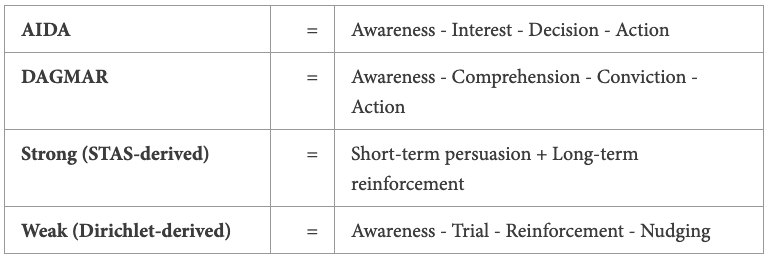
The primal theme here is this: by guiding their initial focus, it's possible to influence your audience. In a style, it's almost 'nudging' your audience to call up most something, having not actually changed the choices available to them.
The quest for attention goes on
It's no secret that your attending and focus are one of the nearly valuable bolt of the digital age. Advertisers and publishers know this very well, which is how their commercial relationship has grown ever tighter and more than complex as the web becomes more sophisticated and diverse.
To come full circle on that initial note on the idea of attention equally a transaction — I do firmly believe at that place is a sort of tacit reciprocal relationship which occurs when we pay attention to something. In a perfect earth, both the consumer and the advertiser benefit from this relationship. Simply this is seldom the case, as online content grapples, claws and struggles its mode to grab that miniscule sliver of our time and thoughts. In a manner, we've brought this upon ourselves. The want for unending free online content has forced publishers to adopt the advertiser-funded model, where audiences are packaged up, bought and sold in an instant, their attention commoditised and made tangible, through fuzzy metrics like return on advertizing spend and view-through rates.
There's certainly more to explore on this topic, but I'll take to give my attention to that another time.
Thank you for reading. If you establish this commodity interesting, please press (and hold) the 👏 button and remember to follow Brandjaxed for more articles like this i.

Thanks for reading The Marketing & Growth Hacking Publication
Join our Facebook Group. Contact usa for a sponsored post. Write for united states of america. Need help growing your business organisation to the side by side level?
Automate your Twitter sharing to increment engagement.
Source: https://blog.markgrowth.com/capturing-attention-is-an-art-maintaining-it-is-all-science-daea464104ad
0 Response to "How to Keep My Attention Ob a Piece of Art"
Enviar um comentário